Why Fit in Giraffe Quote Funny SVG: Graphics for Crafts & Creative Brands
As a brand designer who’s helped over 200 small businesses refine their visual voice—and as a content marketer who’s built campaigns across Instagram, Pinterest, and email—I opened Why Fit in Giraffe Quote Funny SVG expecting whimsy. What I found was something more strategic: a tightly composed, emotionally resonant graphic design asset that balances levity with clarity. It landed during a real project—refreshing the visual toolkit for a mindfulness coaching brand launching a “Own Your Uniqueness” digital course—and immediately earned a spot in our campaign’s core assets.
First Impression: Playful Confidence, Not Just Cute
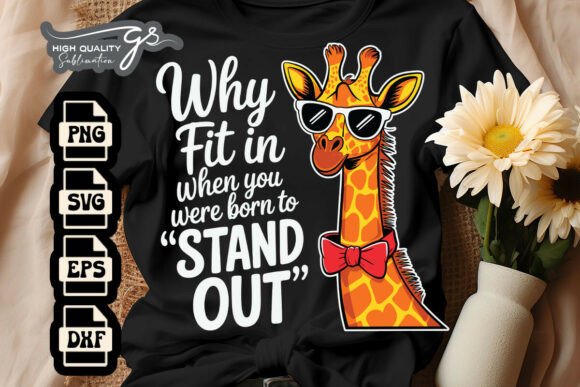
The giraffe isn’t cartoonish or overly detailed—it’s stylized with clean vector lines, generous negative space, and intentional asymmetry. The quote “Why Fit In?” curves gently beneath it, set in a friendly, rounded sans serif. This isn’t clipart; it’s a creative design built for intentionality. It signals approachability, self-expression, and gentle rebellion—ideal for lifestyle brands, online coaches, indie makers, and educators targeting audiences aged 25–45 who value authenticity over polish. It leans into casual branding without sacrificing professionalism—a rare sweet spot for small business branding.
Where It Shines in Real Marketing Workflows
In our course launch, we used Why Fit in Giraffe Quote Funny SVG across six high-impact touchpoints:
- Social media graphics: As a recurring visual motif in Instagram carousels and Pinterest pins—paired with soft pastel backgrounds and clean typography—to reinforce campaign messaging without visual fatigue.
- Digital ads: Cropped tightly for Facebook and Meta ads, where its bold silhouette and clear typographic hierarchy stopped scrollers mid-feed.
- Email banners & lead magnets: Resized for mobile-first previews, it anchored a free printable “Uniqueness Audit” guide—adding warmth and memorability to an otherwise text-dense offer.
- Branded Canva templates: Embedded into editable social post and story templates shared with community members—making consistent, on-brand content creation effortless.
- Packaging accents: Printed at 1.5” height on kraft thank-you cards inside course kits—elevating perceived value while reinforcing brand ethos.
- Editorial design: Used as a decorative element in blog headers and newsletter footers—not as filler, but as a visual signature that builds recognition over time.
How It Strengthens Brand Communication
This SVG design supports stronger first impressions by offering instant emotional resonance—no explanation needed. Its visual hierarchy is instinctive: eye goes to the giraffe, then follows the curve of the quote. That simplicity builds audience trust faster than complex illustrations. When layered over a muted background and paired with a strong headline (“You’re Built for More Than Blending In”), it creates memorable campaign visuals without clutter. For small business owners managing their own marketing, it delivers professional branding without requiring design expertise—making it a true digital product that scales creative output.
Best-Fit Applications for Crafts & Graphics Buyers
Why Fit in Giraffe Quote Funny SVG excels as a hero graphic for seasonal offers (think “Back-to-Self School Year Launch”), a campaign header for podcast intros or webinar slides, and a decorative brand element in printable planners or content bundles. It works beautifully as a product label accent on handmade goods, a subtle watermark on digital product visuals, or a joyful anchor in editorial layouts for blogs covering creativity, wellness, or entrepreneurship. Its vector format means it scales flawlessly—from a 48” event banner to a 2” sticker—making it a versatile addition to any design bundle.
Where to Use It Thoughtfully
This graphic design asset isn’t ideal for formal corporate branding, legal disclaimers, or dense infographics where clarity trumps charm. Avoid placing it on low-contrast backgrounds (e.g., light gray text on white), in tiny mobile-only contexts (under 36px tall), or alongside competing visual elements like photo overlays or multiple icons. It can feel out of place in ultra-minimalist or luxury-leaning brands—especially those relying on serif typography or monochrome palettes—unless intentionally juxtaposed for contrast.
Pro Designer Notes Before You Deploy
Before integrating Why Fit in Giraffe Quote Funny SVG into live campaigns, run these quick checks:
- Test it against your full brand color palette—not just primary hues, but neutrals and tints.
- Convert to black and white: Does the silhouette retain impact? Is the quote legible?
- Drop it into real mockups—website headers, Instagram story frames, Canva templates—to assess balance and spacing.
- Preview on mobile: Does the curve of the text remain readable at 16px? Does the giraffe read as a cohesive shape?
- Compare it to top-performing competitor visuals—is it distinct enough to stand out, yet aligned with category expectations?
- Pair it with your brand fonts: It harmonizes best with rounded sans serifs and friendly display fonts—but test with script or handwritten styles for contrast-driven moments.
- Confirm commercial licensing: This printable design is cleared for use in client work, paid ads, and digital product visuals—just verify scope before scaling.
A Strategic Asset, Not Just a Decoration
At its core, Why Fit in Giraffe Quote Funny SVG is more than a fun illustration—it’s a ready-made piece of brand language. For marketers building visual consistency across channels, for bloggers designing Pinterest-optimized content, for digital sellers creating cohesive product bundles, and for creative entrepreneurs launching their first signature offer, it delivers emotional clarity fast. It doesn’t ask for attention—it earns it. And in today’s saturated feed-driven landscape, that’s not just convenient. It’s commercially intelligent modern design. Whether you’re sourcing from a creative marketplace or building a commercial design system in-house, this SVG design proves that humor, heart, and strategic simplicity can coexist—and convert.